
TL;DR
- Working memory is the small amount of information you can hold while making a choice.
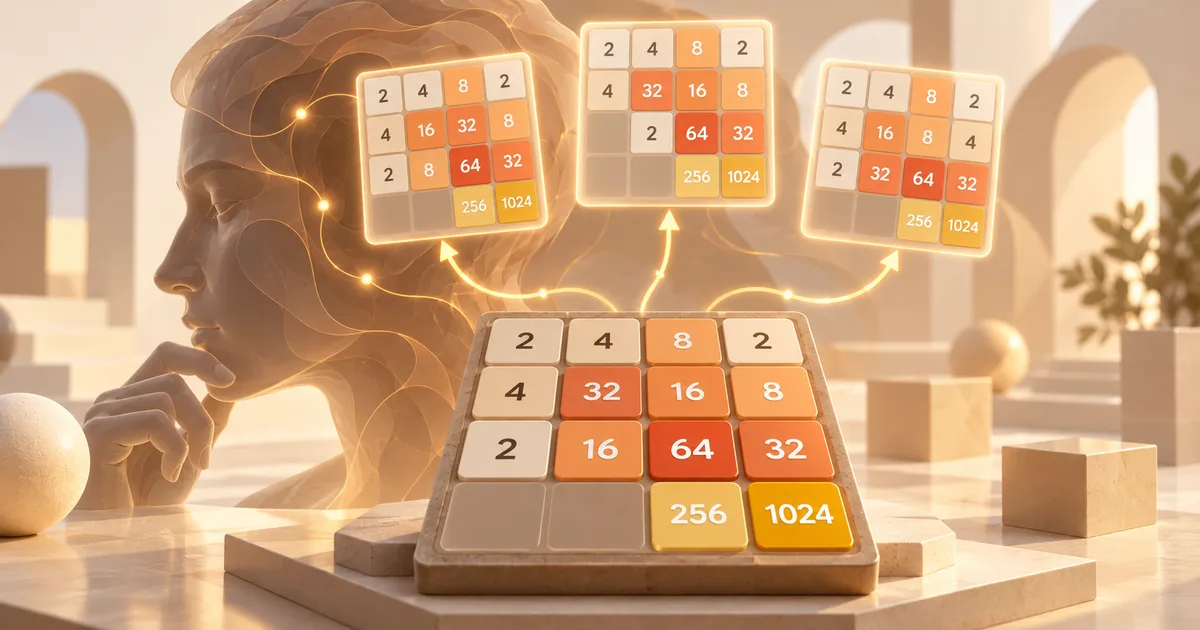
- In 2048, it helps you picture where tiles will land after the next two or three swipes.
- You do not need to remember the whole board. Track your corner, your next merge, and your open cells.
- Short, careful games train this skill better than long sessions full of fast swipes.
You may know the right 2048 strategy and still lose the board. The problem often starts between moves. You see one useful merge, swipe toward it, and forget what that swipe will do to the rest of the grid. A strong move is not only good now. It also leaves you a safe next move.
Working memory helps with that job. It is the small mental notepad you use when you hold a phone number, follow two directions, or picture a tile moving across the classic 4×4 board. It has limits. Good players work with those limits instead of trying to remember everything at once.
What working memory does during a game
Each swipe changes every row or column. Equal tiles may merge. Empty cells may move. Then a new 2 or 4 appears. Your brain tries to picture those changes before your hand moves.
That sounds like a lot, but you only need to hold three useful facts:
- Your anchor: Where is your largest tile, and will it stay in its corner?
- Your next pair: Which two equal tiles are you trying to bring together?
- Your space: How many empty cells will remain after the swipe?
These facts matter more than the exact place of every small tile. They also fit the basic 2048 board patterns you already use. Your corner gives the board a direction. Your next pair gives you a short goal. Open cells give you room to recover.
Use a simple three-move check
Pause before a risky swipe and run this short check. It takes only a few seconds once it becomes a habit.
- Picture the first move. Follow the largest tiles and the pair you want to merge.
- Find the reply. Ask which direction will still be safe after the new tile appears.
- Keep an exit. Make sure one more move can open the board if the spawn lands badly.
You are not trying to predict the random tile. You are checking whether the board can handle more than one result. If a move works only when a new tile lands in the perfect cell, it is a weak move.
Signs that your mental notepad is full
Working memory gets worse when you are tired, rushed, or upset. The board may look clear, yet you lose track of the plan you made five seconds ago. Watch for these signs:
- You forget which corner you chose.
- You make the same unsafe swipe twice.
- You see a merge but miss the tile blocking it.
- You cannot explain what your next move is meant to set up.
- You start swiping faster as the board gets tighter.
When this happens, stop for one full breath. Look only at the anchor, the next pair, and the empty cells. If you still cannot name a safe plan, take a short break. More speed will not bring the plan back.
Train the skill while you play
You do not need a special brain game. Practice inside 2048, where the skill has a clear purpose. Play one careful game and say your plan in a short phrase before each hard move. Try “keep the 512 down,” “join the two 64s,” or “save two empty cells.”
After the game, open your game history and look at the last few turns. Find the first move where your plan became unclear. Do not study every swipe. One honest mistake gives you enough to work on during the next game.
The daily challenge is also useful because the tile sequence is shared. You can try the same board again in your head, compare choices, and see where a safer line was available.
Make harder boards feel smaller
A crowded board can overwhelm you because every cell seems important. Break it into parts. First check the edge that holds your largest tiles. Then check the row or column that feeds that edge. Last, scan the other cells for a pair that can free space.
This turns one large problem into three small ones. It also keeps your eyes from jumping around the grid. When the board is calm, you can look farther ahead. When it is tight, shorten the plan and protect one safe move at a time.
How working memory makes your 2048 strategy steadier
Better working memory does not mean holding all 16 cells in your head. It means keeping the right few facts active long enough to make a clean choice. Your corner, next pair, and open space are enough for most turns.
Use the three-move check when the board becomes risky. Slow down when your plan disappears. Review one mistake after each game. With practice, you will notice danger earlier and recover with less panic. That steady thinking is what turns a strategy you know into moves you can trust.