Why Tile Game Variety Makes You a Stronger Competitive 2048 Player
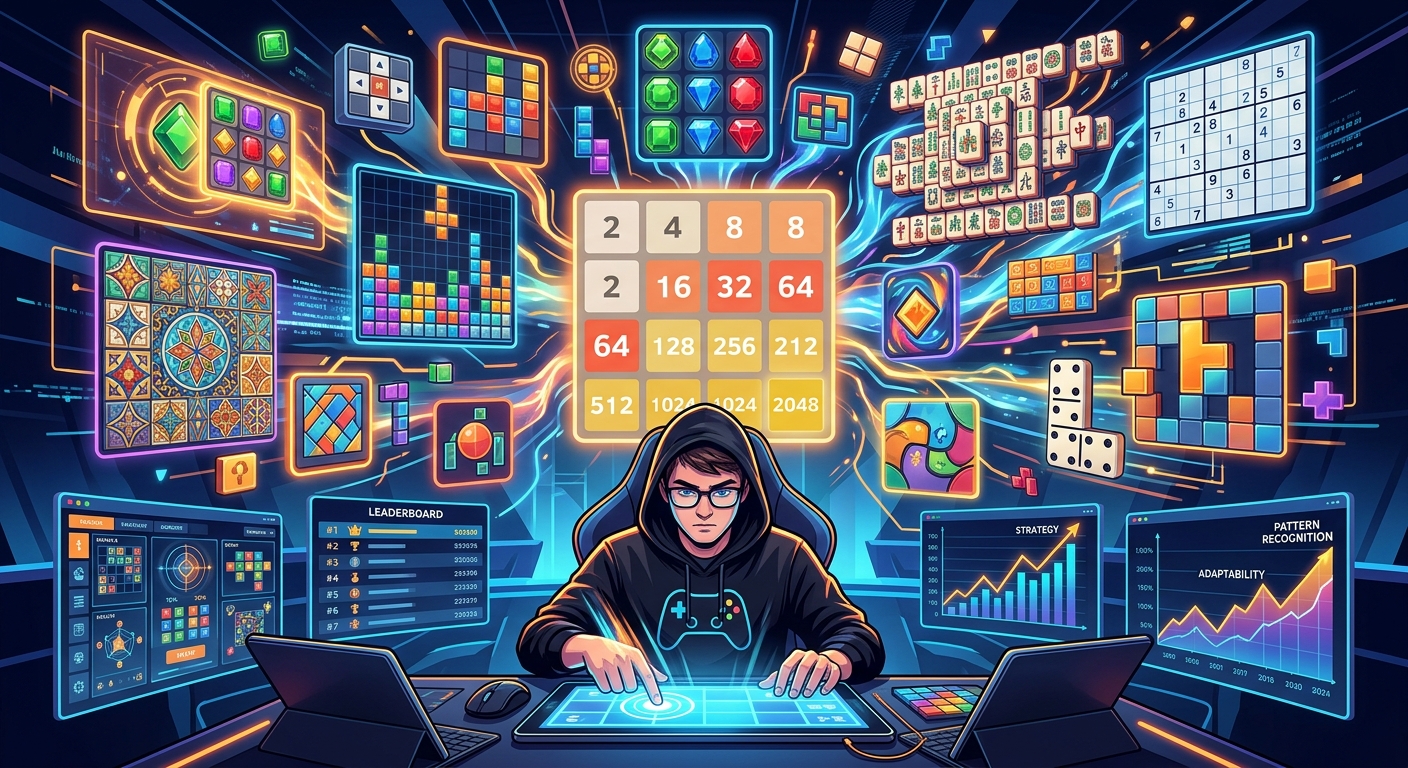
Most competitive 2048 players grind the same grid until their eyes blur. They chase the 2048 tile, then the 4096, then beyond. But the players who consistently top leaderboards share a habit that has nothing to do with logging extra hours on the same board. They play other tile games. And that habit is doing real cognitive work between sessions.
Cross-training with tile games builds the spatial and pattern recognition skills that 2048 demands at its highest levels.
- Different tile formats train distinct cognitive skills that transfer directly to 2048 strategy.
- Social tile games like Mahjong act as low-stakes active rest that rebuilds spatial instincts without burnout.
- Corner anchoring and merge-chain planning both improve when your brain has been exposed to varied tile-based problem-solving.
Your Brain Builds Pattern Libraries Across Every Tile Game It Plays
When you slide a tile in 2048, your brain is not just executing a move. It is scanning the board for opportunities, weighing chains of future merges, and holding a spatial map of what the grid could look like three moves from now. That kind of processing is not unique to 2048. It is a general cognitive skill that tile games develop, regardless of the specific ruleset.
The spatial reasoning you use to read a Mahjong hand involves pattern matching across a set of visual objects arranged in groups. That is not so different from reading a 2048 grid and spotting where a merge chain could extend toward your anchor corner. The more pattern types your brain has processed, the faster it recognizes them in new contexts. Playing only one tile game limits that library. Playing several expands it significantly.
This is not guesswork. Research on spatial cognition confirms meaningful overlap in how the brain processes and represents spatial information across different puzzle formats. The brain does not maintain entirely separate systems for different types of spatial tasks. That overlap is exactly what makes tile game cross-training a legitimate strategy rather than a distraction.
Why Repetition Alone Produces Diminishing Returns
There is a ceiling effect in pure repetition. After a certain point, more hours on 2048 does not produce proportional gains. You start reacting to familiar board states rather than genuinely reasoning. Your moves become habitual rather than strategic. That is when cross-training pays off most.
Exposure to a different tile structure forces your brain to build new pattern templates. When you return to 2048 after a session of something cognitively adjacent, those new templates get applied to the familiar grid. The result is a slightly different perspective on boards you thought you already understood.
Athletes call this cross-training. Musicians call it studying adjacent styles. The underlying mechanism is the same: variety prevents the cognitive plateaus that repetition creates. Competitive puzzle gaming is no exception.
How Different Tile Formats Stress-Test Different Thinking Modes
Not all tile games train the same skills. Some emphasize visual pattern matching. Others push sequential planning or rapid spatial reorientation. Knowing what each format trains helps you pick cross-training activities that target your specific weaknesses as a 2048 player.
How Core Tile Formats Compare As Cognitive Training Tools
| Tile Format | Primary Cognitive Demand | 2048 Skill It Sharpens | Training Intensity |
|---|---|---|---|
| 2048 (standard) | Sequential merge planning | Direct practice | High |
| Mahjong | Spatial grouping and sequence recognition | Corner anchoring, merge-chain reading | Medium |
| Tetris | Real-time spatial rotation and fit | Grid-density awareness | High |
| Shanghai (tile matching) | Visual scanning across a wide tile field | Rapid board-state reading | Low |
| Blokus | Territory control and spatial forecasting | Long-range board planning | Medium |
No single format trains every skill that competitive 2048 demands. A varied rotation covers the gaps that focused grinding leaves open.
Social Tile Formats As Active Rest Between Ranked Sessions
One of the most underrated problems in competitive 2048 play is cognitive fatigue. After a long ranked session, your decision quality drops. Corner anchoring gets sloppy. Merge chains fall apart because you stop thinking two or three moves ahead. Grinding longer at that point does not help. It reinforces bad habits.
Active rest solves this. The concept is borrowed from athletic training. Instead of going completely passive between intense efforts, you engage in something lighter that keeps the relevant systems warm without adding to the load. For 2048 players, a social tile game fits that role exactly.
Mahjong is the format that delivers most here. It is tile-based, spatially demanding, and genuinely engaging. But it runs at a slower pace than a timed 2048 run. It forces you to think about tile relationships and groupings, which feeds directly into the pattern recognition you need on the 2048 grid. Because it is social, it keeps the session enjoyable rather than punishing.
Organizing a Mahjong party with fellow puzzle players is one of the most effective resets you can make before returning to the leaderboard grind. You get the cognitive reset, the spatial priming, and the low-stakes competitive interaction that restores focus without draining your decision-making reserves. A group of puzzle-minded players brings exactly the right energy. The spatial problem-solving that Mahjong demands leaves your board-reading instincts sharper than any passive break could manage.
When you sit back down at your 2048 grid after a session like that, things click differently. Merge paths that would have been invisible now seem obvious. The board feels less static.
What to Watch for During Cross-Training Sessions
Cross-training is most effective with some intention behind it. You do not need to analyze every move. But staying loosely aware of how you are thinking helps you extract more from each session. These are the patterns worth noticing:
- Notice when you hold back a move to preserve a future grouping. That is merge-chain thinking activating in a different context.
- Pay attention to how you reorient yourself to the board after a disruptive play. That reorientation speed matters during a 2048 run.
- Watch how you scan for available options across the full tile field rather than fixating on one area. This directly combats tunnel vision.
- Observe whether you default to short-term wins or hold out for higher-value combinations. That instinct transfers straight to the 2048 grid.
You are not playing Mahjong to get better at Mahjong. You are using it as a spatial workout. The stronger your general tile intuition gets, the more fluidly it expresses itself when you return to the 4x4 grid.
Corner Anchoring and Merge Chains Sharpen After Cross-Training
Corner anchoring is the foundation of high-level 2048 play. You keep your highest tile locked in a corner and build merge chains that feed toward it. The discipline this requires is not just about knowing the rule. It is about reading the board well enough to maintain the chain while new tiles appear and threaten to break it.
That board-reading ability, specifically the capacity to hold a mental model of the current state while planning several moves ahead, is exactly what varied tile game exposure builds. When you have spent time identifying groupings in Mahjong or tracking spatial fits in other tile formats, your working memory for grid states becomes more efficient. Holding the board model costs less mental effort. That freed-up capacity goes directly into better planning.
Merge-chain planning works the same way. The better your general pattern recognition, the faster you spot where a merge sequence can begin and how far it can extend before it collapses. Players who have trained that recognition across multiple tile formats tend to see longer chains and execute them with fewer wasted moves. This is not a marginal gain. At high levels, where a single misplaced merge can end a run, it is the difference between a mid-range score and a leaderboard finish.
The spatial templates your brain builds from Mahjong group-reading or Tetris fit-prediction do not sit in a separate mental folder. They get folded into the same spatial toolkit you call on every time you assess a 2048 board. That is the mechanism. That is why variety is not a distraction from competitive play. It is part of the training.
Making Variety a Permanent Part of Your Training Rotation
The players who benefit most from cross-training are not the ones who try it once. They are the ones who build it into their regular rhythm. A few sessions per week that include a different tile format, especially a social one with other players, keeps the cognitive benefits compounding over time.
You do not need a rigid schedule. The goal is variety with intention. When your 2048 runs feel stale, when your ranking progress slows, or when you notice your corner strategy breaking down from fatigue, those are the signals to rotate. Take the break with a tile game that demands spatial thinking. Come back to the grid with a fresher pattern library and a board that suddenly looks full of options you were not seeing before.
The players grinding the same board in the same way will hit their ceiling. The players cross-training across tile formats will keep finding new headroom in a game they thought they already knew.