
TL;DR
- A new 2 or 4 appears after each valid move, but you control how much open space it can use.
- Tiles merge from the side you swipe toward, and each tile can merge only once in that move.
- A corner keeps your largest tile safe and makes the rest of the board easier to order.
- Before you swipe, check tile order, the next useful pair, and the number of empty cells.
2048 has a random part, but it is not a game of pure luck. You cannot choose where the next tile appears. You can choose the shape of the board it lands on. That one difference gives you room to plan.
You do not need to think like a computer. You only need to know what the game does after a swipe and which board shapes leave you a safe next move. Try these ideas on the classic 2048 board as you read.
New tiles are random, but space is not
After a valid move, 2048 adds a new tile to an empty cell. It is usually a 2 and sometimes a 4. You do not know which empty cell the game will choose.
That sounds unfair until you notice what you control. A board with six empty cells can handle several bad spawns. A board with one empty cell may fail after a single awkward 2. Saving space gives the random tile fewer ways to hurt your plan.
This is why a small merge is not always the best move. If it closes two empty cells or breaks your high-tile chain, the quick points may cost you later. Count open cells before and after the swipe.
Swipe direction sets the merge order
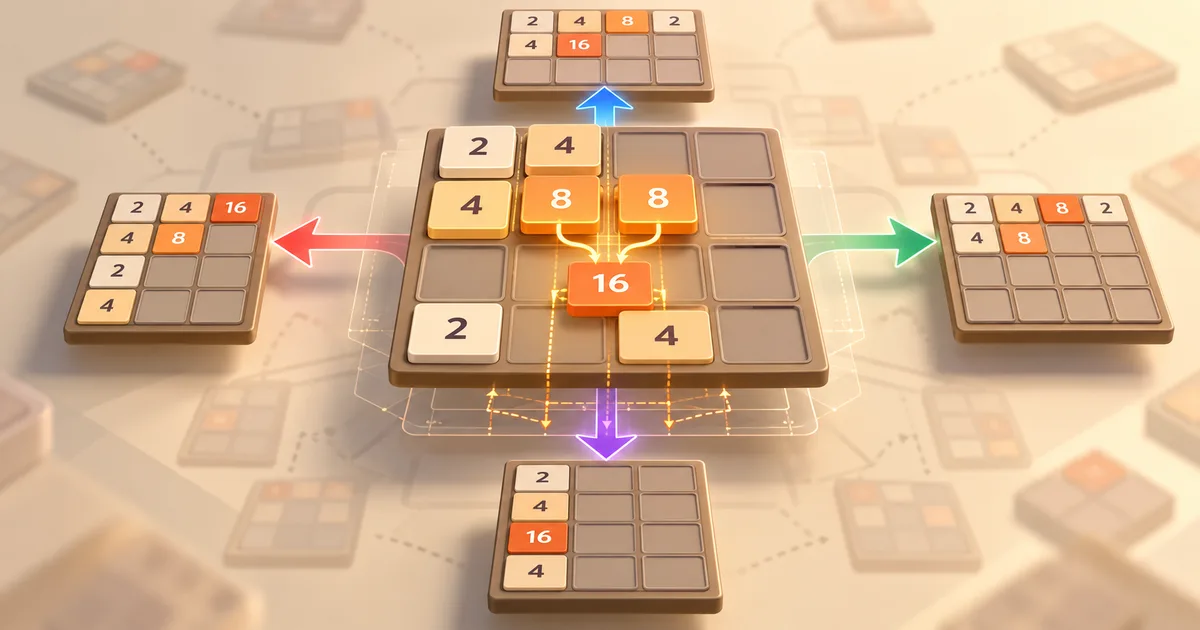
All tiles slide at the same time, but the game resolves them from the side you swipe toward. A row of 2, 2, 2, 2 becomes 4, 4. It does not jump straight to 8. Each tile gets one merge in that move.
Order matters most when three equal tiles sit in one row. If you have 4, 4, 4 and swipe left, the left pair joins first. Swipe right, and the right pair joins first. The same tiles can leave a different board.
Before a busy swipe, trace the leading pair first. Then follow the next pair. This small habit prevents many surprise merges and supports the useful board patterns that keep high tiles together.
Why the corner plan fits the rules
A large tile in the middle can be blocked on four sides. A large tile in a corner has two walls around it. Those walls act like free support, so you only need to manage two open sides.
The corner also gives your tiles a clear order. Put the largest tile in the corner. Place the next largest beside it. Keep stepping down in value along the edge. When a matching tile arrives, the chain can fold toward the anchor instead of breaking apart.
The plan is not perfect. You may need one move away from the corner to escape a tight board. The key is to know how you will bring the anchor row or column back before you make that move.
What a 2048 bot checks
Strong computer players test many future boards. One common method is called Expectimax. The bot tries each possible swipe, adds the possible new tiles, and gives each result a score. It repeats that process several moves ahead.
You cannot test thousands of boards in your head, and you do not need to. The bot's score usually favors the same plain things a human can see:
- more empty cells;
- large tiles held near one corner;
- values that fall in a steady order across a row or column;
- equal tiles that can meet without breaking that order.
Watch a few live 2048 games and look for those four signs. Good players may move at different speeds, but their boards often keep the same basic shape.
Smooth rows still need useful pairs
A row such as 512, 256, 128, 64 is easy to control. The values fall in one direction, but there is nothing to merge yet. A row such as 64, 64, 32, 32 has two quick merges, but it may not support your largest tile.
Your job is to balance both needs. Keep the big tiles in order, then build matching small tiles on the open side. Larger grids give you more room to do this, but they also give you more tiles to track. The 5×5 board is a good place to feel that tradeoff.
Use three checks before each hard swipe
- Order: Will my largest tiles still fall toward the same corner?
- Pair: Which equal tiles will meet, and which pair will merge first?
- Space: Will this move leave enough empty cells for a bad spawn?
If a move fails two of these checks, look again. A slower swipe that protects the board is often better than a quick merge. The help center has more board guides when one part of the plan needs extra practice.
Use the 2048 algorithm to choose better moves
The algorithm does not hand you a secret winning move. It shows you what stays under your control. New tiles are random. Merge order, tile order, and open space are not.
Keep one corner, follow the leading pair, and count the empty cells. When two moves look close, choose the one that leaves more safe replies. That is the simple human version of looking ahead, and it can make every 2048 game feel less random.